

THE CENTER’S 9 · CULTURE, HISTORY & HOLIDAYS
Center Focus · Knowledge Corner · November 2026
Thanksgiving and Christmas are seasons of giving. But did you know that in Taiwan, even a well-intentioned gift can carry an unexpected meaning?
From unlucky wordplay to special customs, here’s a quick guide to help you choose gifts with confidence.
Think Twice Before Giving…
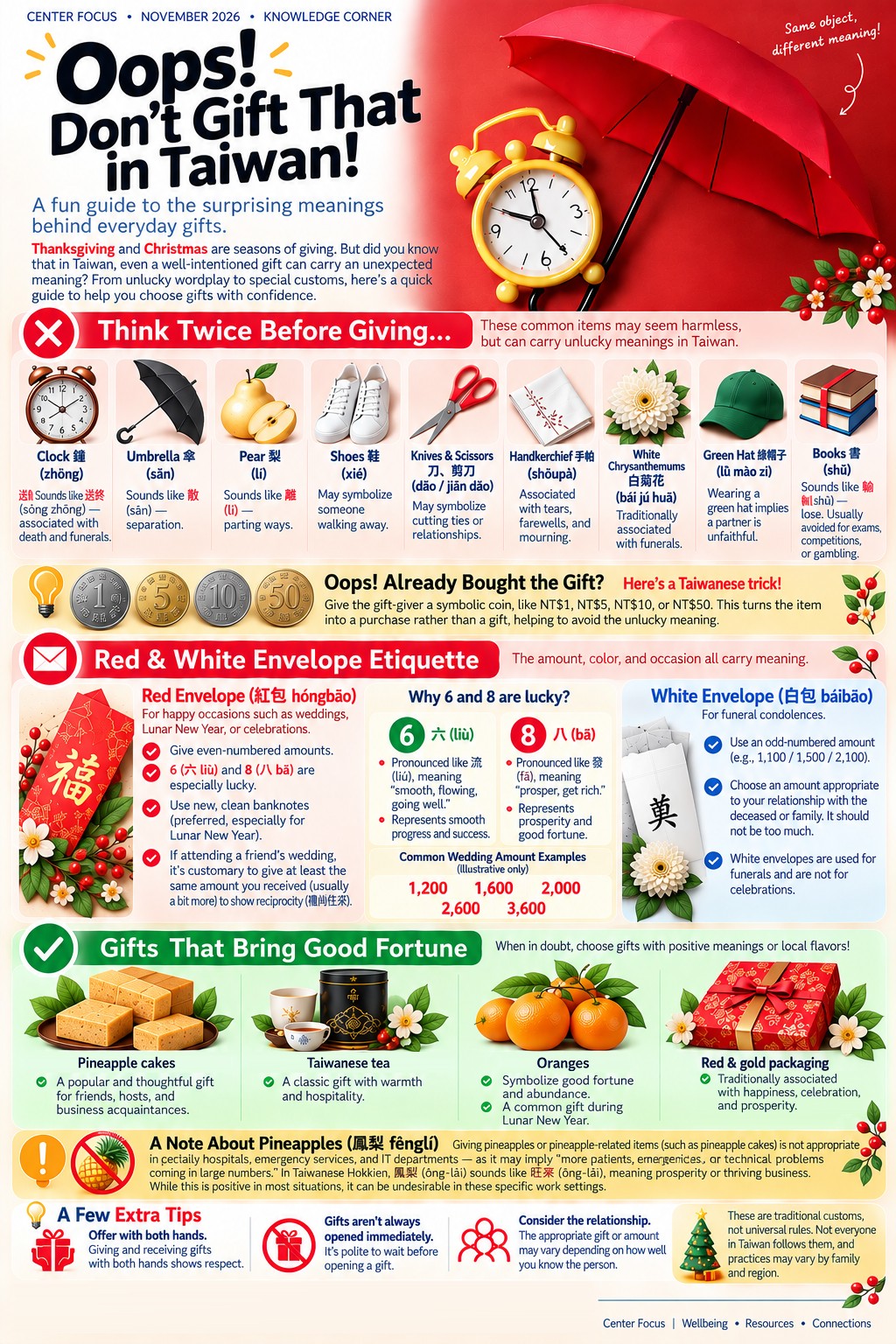
These common items may seem harmless, but can carry unlucky meanings in Taiwan. Same object, different meaning!
✕ Clock 鐘 (zhōng)
送鐘 (sòng zhōng) sounds like 送終 — associated with death and funerals.
✕ Umbrella 傘 (sǎn)
Sounds like 散 (sàn) — separation.
✕ Pear 梨 (lí)
Sounds like 離 (lí) — parting ways.
✕ Shoes 鞋 (xié)
May symbolize someone walking away.
✕ Knives & Scissors 刀、剪刀 (dāo / jiǎndāo)
May symbolize cutting ties or relationships.
✕ Handkerchief 手帕 (shǒupà)
Associated with tears, farewells, and mourning.
✕ White Chrysanthemums 白菊花 (bái júhuā)
Traditionally associated with funerals.
✕ Green Hat 綠帽子 (lǜ màozi)
Wearing a green hat implies a partner is unfaithful.
✕ Books 書 (shū)
Sounds like 輸 (shū) — lose. Usually avoided for exams, competitions, or gambling.
Oops! Already bought the gift? Here’s a Taiwanese trick!
Give the gift-giver a symbolic coin, like NT$1, NT$5, NT$10, or NT$50. This turns the item into a purchase rather than a gift, helping to avoid the unlucky meaning.
Red & White Envelope Etiquette
The amount, color, and occasion all carry meaning.
Red Envelope (紅包 hóngbāo)
For happy occasions such as weddings, Lunar New Year, or celebrations.
- Give even-numbered amounts.
- 6 (六 liù) and 8 (八 bā) are especially lucky.
- Use new, clean banknotes (preferred, especially for Lunar New Year).
- If attending a friend’s wedding, it’s customary to give at least the same amount you received (usually a bit more) to show reciprocity (禮尚往來).
NT$1,200 · 1,600 · 2,000 · 2,600 · 3,600
White Envelope (白包 báibāo)
For funeral condolences.
- Use an odd-numbered amount (e.g., 1,100 / 1,500 / 2,100).
- Choose an amount appropriate to your relationship with the deceased or family. It should not be too much.
- White envelopes are used for funerals and are not for celebrations.
Why are 6 and 8 lucky?
- 6 (六 liù) is pronounced like 流 (liú), meaning “smooth, flowing, going well.” It represents smooth progress and success.
- 8 (八 bā) is pronounced like 發 (fā), meaning “prosper, get rich.” It represents prosperity and good fortune.
Gifts That Bring Good Fortune
When in doubt, choose gifts with positive meanings or local flavors!
✓ Pineapple cakes
A popular and thoughtful gift for friends, hosts, and business acquaintances.
✓ Taiwanese tea
A classic gift with warmth and hospitality.
✓ Oranges
Symbolize good fortune and abundance. A common gift during Lunar New Year.
✓ Red & gold packaging
Traditionally associated with happiness, celebration, and prosperity.
A note about pineapples (鳳梨 fènglí)
Giving pineapples or pineapple-related items (such as pineapple cakes) is not appropriate in certain workplaces, especially hospitals, emergency services, and IT departments, as it may imply “more patients, emergencies, or technical problems coming in large numbers.” In Taiwanese Hokkien, 鳳梨 (ông-lâi) sounds like 旺來 (ōng-lâi), meaning prosperity or thriving business. While this is positive in most situations, it can be undesirable in these specific work settings.
A Few Extra Tips
- Offer with both hands. Giving and receiving gifts with both hands shows respect.
- Gifts aren’t always opened immediately. It’s polite to wait before opening a gift.
- Consider the relationship. The appropriate gift or amount may vary depending on how well you know the person.
These are traditional customs, not universal rules. Not everyone in Taiwan follows them, and practices may vary by family and region.
🔍 Click the image to zoom in · drag to move · Open full size ↗